


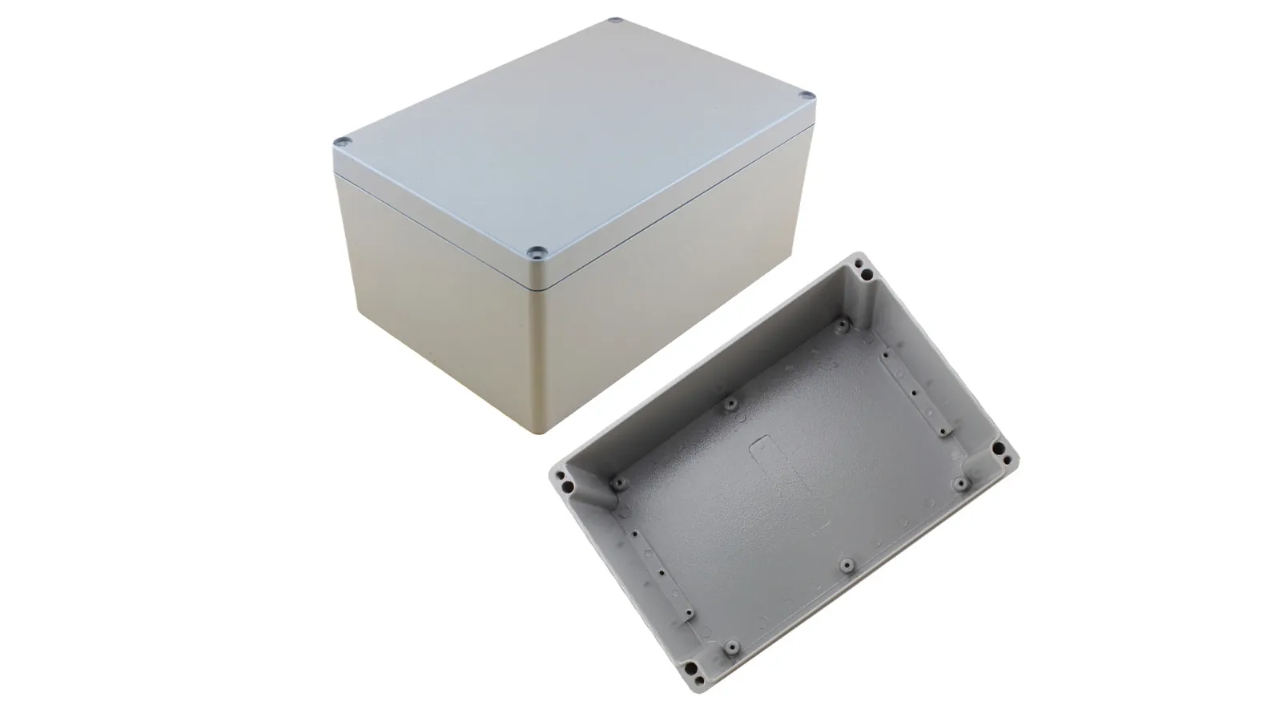
Aluminum and plastic are widely used as enclosure materials. The materials directly affect your equipment protection, system reliability, and long-term cost. This article helps electrical engineers and system integrators understand the main differences and applications of aluminum and plastic enclosures, and helps you choose the right enclosure for your project.
What Are Aluminum Enclosures?

Aluminum enclosures are typically made of aluminum or an aluminum alloy. They protect electrical, electronic or control components from damage. They have high strength, durability and excellent heat dissipation.
Besides, EMI(electromagnetic interference)/RFI(radio frequency interference) shielding is an advantage of aluminum enclosures. Lightweight and corrosion-resistant aluminum enclosures are widely used in industrial automation systems, outdoor electrical installations, telecommunications equipment, and control panels.
What Are Plastic Enclosures?

Plastic enclosures are typically protective enclosures made of ABS, polycarbonate, or fiberglass-reinforced polyester. They protect electrical and electronic components from environmental factors, dust and moisture.
The excellent insulation and corrosion resistance of plastic enclosures make them widely used in indoor power distribution systems, telecommunications equipment and outdoor installations. Plastic enclosures are a practical and economical option for many applications.
Key Differences Between Aluminum and Plastic Enclosures

Mechanical Strength and Impact Durability
The structural strength and stiffness of aluminum enclosures are better than those of plastic enclosures. An aluminum enclosure can withstand heavy mechanical loads, strong impacts and vibrations. This makes the aluminum enclosure ideal for applications in factories, outdoor infrastructure, and heavy-duty applications that require physical protection.
A Plastic enclosure provides medium strength depending on the material. High-grade plastic enclosures are impact-resistant, but not as rigid as metal. And, the plastic enclosure has cracking or deformation risks. Therefore, plastic enclosures are not suitable for high-impact environments.
Corrosion and Chemical Resistance
An aluminum enclosure can form a natural oxide layer to prevent corrosion. But it still corrodes in a strongly acidic/alkaline environment. You can use a surface treatment process (anodizing and powder coating) to increase the long-term durability of the aluminum enclosure.
The plastic enclosure is effective against moisture and humidity. And it also avoids reactions with many chemicals and salts. Plastic has no problems with rust and oxidation compared to metal. As a result, plastic enclosures are widely used in marine, chemical, and food processing environments.
Generally speaking, plastics have better resistance to aggressive chemicals and corrosion.
Weight and Portability
The plastic enclosure is lighter than the aluminum enclosure. Although aluminum is lighter than steel, it still has a certain weight as a metal. If you buy a large enclosure, its weight will be more noticeable.
The lightweight advantages of plastic cases are more obvious. Therefore, plastic cases are easier to transport. They are also faster to install. You can apply them to wall-mounted or portable systems.
Electrical Conductivity
You clearly know that plastic is non-conductive. Therefore, a plastic enclosure doesn’t require grounding. This also improves the safety of your electrical applications. At the same time, the risk of accidental exposure to hazards is reduced.
Instead, the aluminum enclosure needs to be grounded as a conductive material. If you do not install it correctly, it may cause the risk of electric shock.
EMI/RFI Shielding Performance
The conductive aluminum can effectively block electromagnetic interference(EMI) and radio frequency interference(RFI). Therefore, aluminum enclosures are very suitable for your telecommunications equipment, control systems, and signal-sensitive devices.
Plastic enclosures generally do not provide EMI/RFI shielding. You can add special coatings or conductive additives to the plastic enclosure. But this also increases product production complexity and your costs.
Thermal Conductivity and Heat Dissipation
Aluminum enclosures have a higher thermal conductivity than plastic enclosures. This means that aluminum enclosures have great advantages in heat dissipation. Aluminum can dissipate heat from inside the enclosure to prevent your sensitive electronics from overheating.
Plastic is an insulator. It often accumulates heat inside the enclosure. Therefore, plastic enclosures are more suitable for devices with low heat generation or low power. If you use it for high-power devices, you usually need an additional cooling solution.
Weather and UV Resistance
Aluminum is resistant to UV degradation. Aluminum enclosures can maintain their structural integrity even if you use them outdoors for a long time. Compared to aluminum, some plastics may degrade under prolonged UV exposure. Polycarbonate performs more consistently under UV light, which also improves outdoor durability.
Aesthetic and Customization
The aluminum enclosure usually has a metallic texture. And, you can choose to sandblast, anodize, and hard anodize (improve wear resistance) the surface of the enclosure. Screen printing or laser markings have stronger adhesion and are more wear-resistant. Customized aluminum enclosures usually require mechanical processing for manufacturing. But this will also increase your costs and delivery time.
Compared to aluminum, the design of plastic enclosures is more flexible. Plastic enclosures can be directly colored during injection molding. This gives you multiple color and transparency options. And it‘s easier to make complex shapes. But plastic can easily wear out or yellow over time.
Overall, the plastic case can give you more design flexibility and simpler customization.
Cost
For die-cast aluminum enclosures, the mold cost is high. But for extruded aluminum enclosures, they require lower tooling costs. And the unit cost drops with large quantities. What’s more, aluminum enclosures provide better long-term durability in demanding environments, which can offset the initial investment.
Plastic enclosures have lower material costs. Manufacturing difficulty is also lower. Plastic enclosure is good for mass production. What’s more, lightweight plastics are more convenient and have a lower cost to transport, install and assemble. If your project costs are limited, you can choose plastic cases. However, plastic enclosures may need to be replaced frequently in harsh conditions.
Applications
An aluminum enclosure has excellent impact resistance and durability, so it is very suitable for industrial environments. Besides, the aluminum enclosure’s natural corrosion resistance and UV resistance make it ideal for outdoor applications. If you need to shield against EMI/RFI, the aluminum enclosure is also a great choice. You can also apply it in high-temperature applications.
The plastic enclosure is very lightweight and allows signals to pass through. At the same time, it has excellent corrosion resistance and insulation properties. Therefore, you can apply it in indoor or light industrial environments. Besides, the plastic enclosure can also be used in projects that have budget constraints and require lightweight equipment.
What Factors Should Be Considered When Choosing the Right Enclosure?

Environmental Conditions
Your choice depends on the operating environment. For example, you may need corrosion-resistant materials, UV-stable plastic, or a sealed case with a high IP rating. The environment‘s temperature, humidity, and UV also influence your choice.
Protection Requirements
If you apply it outdoors or in an industrial environment, you need a higher IP rating. A high IP rating prevents the ingress of solids and water. This can also effectively prevent your equipment from malfunctioning.
Electrical and Thermal Needs
You should assess insulation, grounding and conductivity needs. And, the heat generated by internal components and ambient temperature conditions also need to be evaluated. Those factors influence your enclosure material and device operational stability.
Size and Internal Layout
The enclosure material is related to the available space of your device. You need to plan the cable entry and routing. And, you also think about the future expansion needs.
Apart from the above factors, the mechanical strength, installation requirements, customization flexibility and cost all need to be carefully considered.
FAQ

Which Is Better for Outdoor Use: Aluminum or Plastic Enclosures?
The aluminum enclosure is better suited to your outdoor applications. The aluminum enclosure has strong resistance to UV rays and extreme temperatures. Besides, it is also shock-resistant and very durable.
What’s more, polycarbonate plastic enclosures can also be used outdoors. They can be applied in corrosive or coastal environments. If you have lightweight and insulation needs, it would be a better option for you.
Which Enclosure Types Are More Cost-Effective for Long-Term Use?
Aluminum enclosures are generally more cost-effective in the long run. Aluminum enclosure has a longer service life in harsh environments and has better impact resistance and wear resistance. Also, you don’t need frequent maintenance and replacement.
In contrast, plastic enclosures degrade more quickly under UV light. Frequent replacement is required under severe conditions.
Can Both Materials Withstand Heavy Rain and Dust in Outdoor Installation?
An aluminum or plastic enclosure with the correct IP rating can withstand heavy rain and dust. Aluminum enclosures generally have better sealing and durability. If your plastic enclosure is made of high-quality materials and seals well, it can also have better performance.
Can Aluminum Enclosures Be Easily Drilled?
Yes. Aluminum is a relatively soft metal. You can machine drill it with standard cutting tools. And, the aluminum enclosure remains structurally intact after drilling. However, you can use a lubricant and sharp bits to avoid burrs.
Which Type of Enclosure Is Best for Telecom And Data Systems?
Aluminum enclosures are usually the best choice for telecommunications and data systems. An aluminum enclosure has better EMI/RFI shielding. The aluminum enclosure has better heat dissipation performance and durability. However, in environments with high interference, you can use an aluminum enclosure and an external antenna.
Final Thought

KDM is a professional electrical enclosure manufacturer. We provide you with diverse enclosures, including stainless steel, plastic, aluminum, and galvanized steel. Besides, we provide customized enclosure services with extensive customization experience and a professional team. We will promptly respond to your requirements and provide samples for you.
 English
  Arabic
  French
  Spanish
  Russian
  Japanese
  Korean
  Portuguese
  Indonesian
  Chinese