


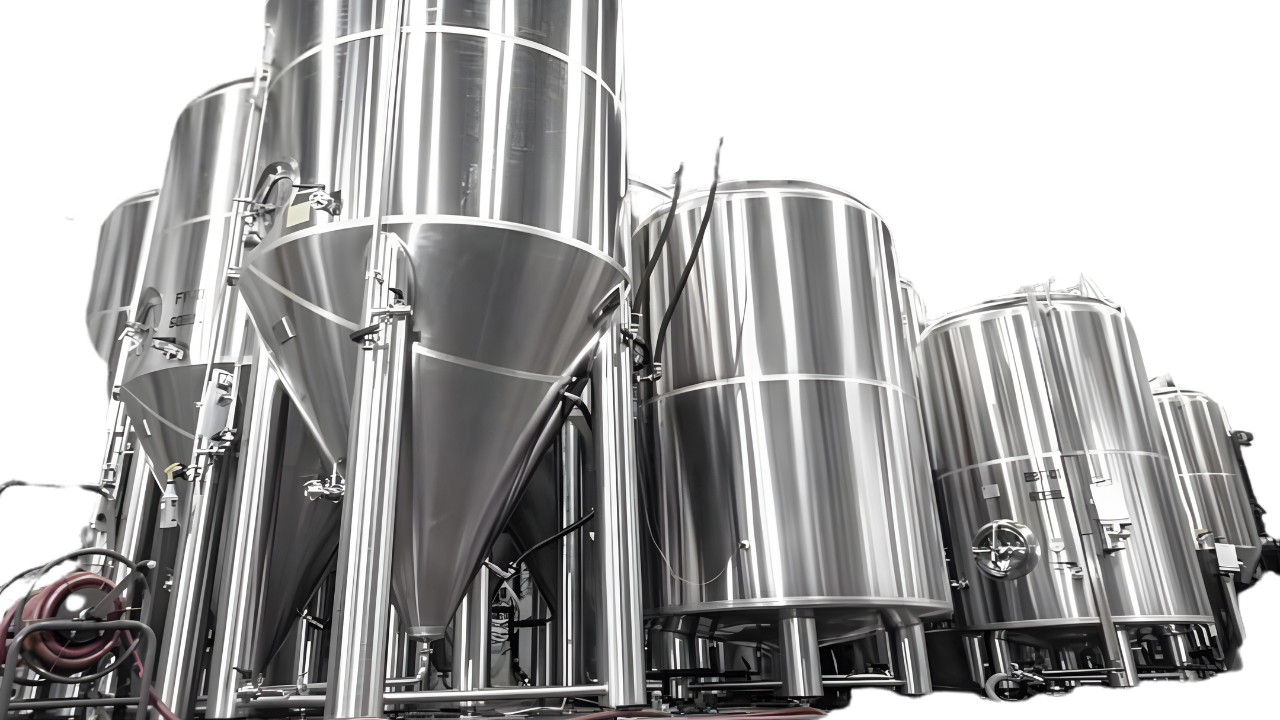
If you are scaling up production, the vessel you choose determines your yield, quality, and capital efficiency. Both fermenters and mixing tanks have agitators and are made of stainless steel. One, though, grows life, while the other mixes ingredients. This guide compares fermenters and mixing tanks, some factors, so that you can decide on the right type of fermenters and tank for your needs.
What Is a Fermenter?

A fermenter is a biosafe container that is clean and made to grow bacteria or mammalian cells. It keeps a tight grip on the foam, pH, temperature, and liquid oxygen. In contrast to simple tanks, fermenters keep things clean and allow for both aerobic and anaerobic growth. Drugs, enzymes, cell treatments, and beer are all made from them.
What Is a Mixing Tank?

A mixing tank is a machine that blends liquids, dissolves powders, or keeps solids in suspension. It puts fluid dynamics ahead of biological control. You can change the speed, the temperature, and sometimes the pressure or vacuum. They are used in a lot of different ways, from salad dressing to chemical processes and pharmaceutical intermediates.
Top 10 Key Differences between Fermenter vs Mixing Tank

1. Primary Purpose & Function
Fermenter
It is possible to grow organisms in a fermenter, such as yeast, bacteria, or mammalian cells. The vessel makes it possible for metabolism and multiplication to happen. Your goal is to produce biomass or collect metabolites. The creature does the work, and the tank grows it.
Mixing Tank
You use a mixing tank to physically combine ingredients. There is no biological activity. You are dissolving powders, diluting concentrates, or creating emulsions. The tank is a blender, not a life-support system. Success is measured in homogeneity, not cell count.
2. Controlled Biological Environment
Fermenter
To stay alive, you must keep certain conditions. A 0.2 pH change can ruin a batch. The temperature can be adjusted to within 0.1°C. Dissolved oxygen is sparged and constantly checked. It is also important to keep cells living and working.
Mixing Tank
If you change the temperature, you change how quickly something dissolves or reacts, but not how alive cells are. It is common to change the pH, but a drift of 0.5 is generally fine. There is no need for oxygen. The most important thing in your control loop is stability, not life support.
3. Aeration & Gas Management
Fermenter
For aerobic fermenters to work, they need clean air or oxygen sparging. Gas is put in through ring spargers or micro spargers on the turbine. Exhaust gas is cleaned to keep aerosols out and keep the gas clean. As a key process parameter, gas flow is observed and controlled.
Mixing Tank
You do not usually add gas on purpose. It is for nitrogen blanketing (to stop rusting) or carbon dioxide for carbonation if you do. Our sparger ring is missing. However, gas is not a food; it is an ingredient or preservative.
4. Sterility & Contamination Control
Fermenter
Sterility cannot be negotiated. The vessel (SIP), the air that comes in, and the feed lines are all sterilized. Two types of mechanical seals are double or electrically driven. You check to make sure that no viruses or bugs get in. One germ beats your culture and destroys the batch.
Mixing Tank
You do not usually run sterile, just clean. The residue from earlier batches is removed by the wash cycle. Even though low bioburden is nice, purity is not needed for mixing syrups or diluting chemicals. Cleaning is not done to protect live cultures, but to stop cross-contamination.
5. Process Monitoring & Automation
Fermenter
You monitor liquid oxygen, CO2 emissions, optical density, and foam. When placed in a sample, probes can be sterilized. If the metabolic demand changes, automation changes the airflow, stirring, and acid/base addition in real time. Enforcing regulations and allowing batch releases require data logging.
Mixing Tank
Monitor the amount, temperature, and speed of the agitator. Track the weights of ingredients with load cells. Time-based or recipe-driven control patterns are both usable. Logging data is a great way to ensure the quality of your work, but closing the control loop around a living object never happens.
6. Scale & Design Complexity
Fermenter
The design is very complicated. You need clean edges, drains for condensation in steam lines, and rupture discs in case of overpressure. Impellers are made for low shear (Rushton or naval blades) so that cells are not damaged. It is hard to scale up because changes in shape make it harder for oxygen to move.
Mixing Tank
The level of complexity is average. If you want high shear or bulk flow, you can choose impellers with hydrofoils or pitched blades. Scale-up comes after numbers with no dimensions (Reynolds, Froude). You do not need to be sterile, so you can use easier shaft seals and open manways.
7. Biological vs Non-Biological Processes
Fermenter
Always involves active biology. Cells take nutrients, discharge metabolites, and produce heat. The process is dynamic and non-linear. You cannot interrupt a fermentation; the metabolism continues until the substrate is depleted or harmful byproducts accumulate.
Mixing Tank
The processes are chemical and physical. It is possible to reverse or direct the processes of dissolution, dilution, suspension, and emulsification. The product will not be harmed if you turn off the agitator, let the pot sit overnight, and then start it up again. There is no life cycle to take care of.
8. Sensitivity to Conditions
Fermenter
Microorganisms are fragile. Impellers’ shear stress can cause cell walls to rupture. Temperature spikes denature enzymes. Foam can clog exhaust filters and create overpressure. You design each component to be soft and responsive.
Mixing Tank
The ingredients are robust. Emulsions can be sheared very hard. Dissolution happens faster at high temperatures. Foam is annoying, but it is not dangerous. You plan for speed and efficiency, not for cells to break easily.
9. Automation & Data Feedback
Fermenter
Automation works in a restricted loop and can change. Data in real time is sent from probes to PID controls or SCADA systems. If the amount of dissolved oxygen goes down, the airflow or agitation goes up naturally. You are after a biological object that is moving. A trend study of the past helps predict future yields.
Mixing Tank
Automation works by following steps and procedures. Put in ingredient A and mix for 5 minutes. Then put in ingredient B and heat to 60°C. Hold for 10 minutes. Feedback loops keep the temperature stable, but the order is set ahead of time. You are following a plan and not reacting to metabolism.
10. Outputs & Applications
Fermenter
You make metabolites or waste. Some examples are probiotics, lactic acid, ethanol, penicillin, yeast cream, and monoclonal antibodies. The biological change inside the vessel makes it more valuable. A substrate with low value can be turned into a high-value food or medicine element.
Mixing Tank
You produce formulated products. Soaps, paint, glues, soft drink syrup, chemical mixes, and buffer solutions are all examples. In homogenization and reaction finish are two ways that the vessel adds value. Ingredients are mixed together, but they are not naturally changed.
Fermenter vs Mixing Tank – Summary Table
| Feature | Fermenter | Mixing Tank |
| Primary Function | Cultivate living cells | Blend non-living ingredients |
| Sterility | Mandatory (SIP/CIP) | Clean, not sterile |
| Aeration | Sterile sparging required | Rare; nitrogen blanket optional |
| Key Sensors | pH, DO, off-gas, foam, OD | Temp, level, load cells, pH |
| Agitator Design | Low shear (Rushton, marine) | High shear or hydrofoil |
| Pressure Rating | Positive pressure for sterility | Atmospheric or low pressure |
| Control Strategy | Adaptive biological feedback | Sequential recipe execution |
| Common Industries | Pharma, biotech, brewing, ethanol | Food, chemical, cosmetics, paint |
| Cost | High (validation + sterility) | Moderate to high |
| Scalability | Complex; OTR limited | Well-understood; geometric |
Fermenter vs Mixing Tank – What’s the Right Choice?
Do you want to grow something or just mix things? You need a fermenter, even if it costs more, if your process needs sterile inoculation, aseptic samples, and keeping the level of dissolved oxygen high. A mixing tank is an efficient and cost-effective way to turn powders into liquids, make batches the same, or combine chemicals without living things. Both are needed by some buildings; they cannot be switched out, but they do work well together.
FAQs
Are fermenters and bioreactors the same thing?
Yes. Fermenters cultivate microbes; bioreactors are a broader term, including mammalian cell culture. In common language, “fermenter” implies microbial; “bioreactor” often implies more complex single-use or perfusion systems.
Can a fermenter also perform mixing tasks?
Yes, but inefficiently. Fermenter impellers are designed for gentle gas dispersion. If you need high shear or rapid powder dissolution, a mixing tank is faster and more energy-efficient.
Is sterilization necessary for fermenters?
Yes. Contamination kills yield. You must sterilize the vessel, media, air, and feed lines. This is typically done via steam-in-place (SIP) systems integrated into the fermenter design.
Do fermenters require aeration systems?
Yes, aerobic fermenters require aeration systems. Anaerobic fermenters (e.g., ethanol, Clostridium) do not require oxygen sparging. However, most industrial fermenters are aerobic and include sterile air filtration and sparging.
Can mixing tanks operate under pressure like fermenters?
Some can, if they are designed in accordance with ASME Section VIII. However, pressure in mixing tanks is often used for heating or transfer, not sterility maintenance. Fermenters are designed to keep pollutants out.
Can manufacturers customize both fermenters and mixing tanks?
Yes. Good manufacturers, like KDM Steel, allow you to make any changes you want. Customization options for fermenters include impeller types, probe holes, and the ratio of height to diameter.
What is the impact of mixing on flavor in fermented foods?
When yeast cell walls are sheared too much, bad tastes come out. By slowly moving fermenters, the organoleptic quality is kept. No harm will come from using the mixing tanks before or after fermentation.
Are there hybrid vessels that combine fermentation and mixing functions?
In fact, some dishes that are multipurpose can be used for both fermentation and formulation. Cross-contamination is a risk in managed fields, so this does not happen very often there. A lot of places keep mixing and fermenting in different areas.
Customized Fermenter and Mixing Tanks by KDM Steel

KDM Steel designs both types of tanks. We make fermenters that are placed on skids and have full CIP/SIP integration and sanitary instrumentation. We also make special mixing tanks with heating jackets, variable-speed drives, and high-efficiency impellers. Contact us today, and our team will provide code-compliant, production-ready tools, whether you need to make a new probiotic bigger or a syrup line more consistent.
 English
  Arabic
  French
  Spanish
  Russian
  Japanese
  Korean
  Portuguese
  Indonesian
  Chinese