


To choose the right MCCB size, you need to know which sizes are available, what each is used for and how their dimensions differ. This guide compares MCCB standard sizes and explains the key parameters that affect your choice.
MCCB Standard Size Chart
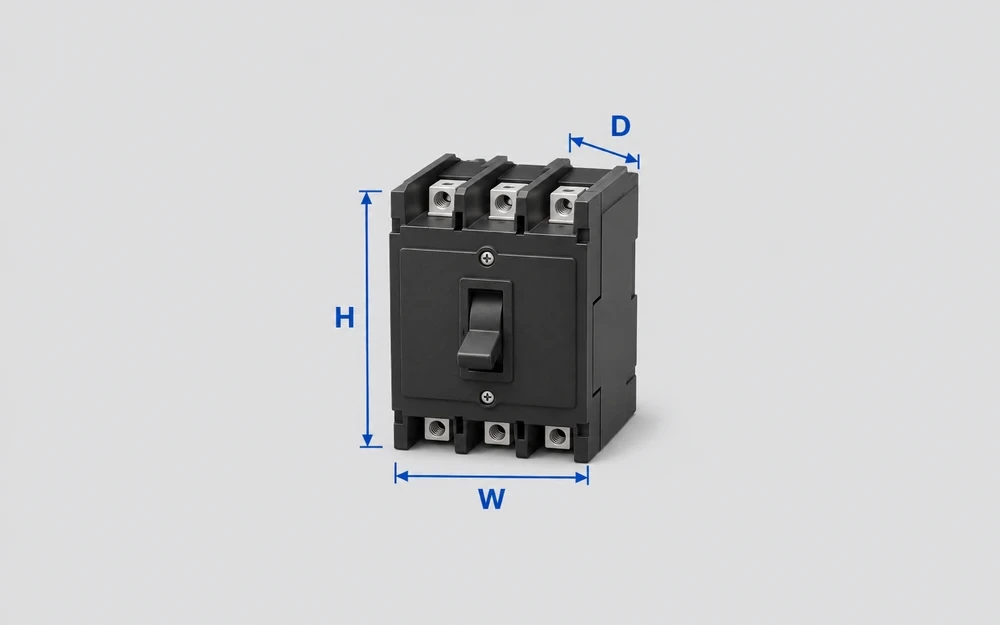
MCCBs are commonly identified by a frame rating, such as 100 A, 250 A or 630 A. Their physical dimensions are given separately as width × height × depth. A frame rating identifies a capacity class; it does not specify one universal body size.
The chart below gives representative three-pole body dimensions from published product data. Some frame ratings appear in more than one row because different designs use different bodies. These are dimensional examples for comparison, not interchangeable mounting footprints.
| Frame reference | Example three-pole dimensions, W × H × D | What the example shows |
|---|---|---|
| 30, 50 and 60 A | 75 × 130 × 68 mm | Several lower-current frames can share one body. |
| 100 and 125 A | 90 × 130 × 68 mm | A compact body can cover more than one frame reference. |
| 100, 160 and 250 A | 105 × 161 × 86 mm | A different product family shares a body across these three frames. |
| 225 and 250 A | 105 × 165 × 68 mm | A similar width can accompany a different height and depth. |
| 400 A | 140 × 260 × 103 mm | One body used for distribution applications. |
| 600 and 630 A | 140 × 260 × 103 mm | A compact option can retain the dimensions of a lower-current frame. |
| 600 and 630 A | 210 × 273 × 103 mm | Another design in this class needs substantially more width. |
| 800 and 1000 A | 210 × 273 × 103 mm | Higher-current options can share this same external size. |
| 1000 A | 210 × 327 × 147 mm | An alternative design is taller and deeper. |
| 1200 A | Approximately 211 × 406 × 140 mm | A three-pole example converted from inch dimensions. |
| 1250 A | 210 × 370 × 120 mm | A documented metric example in a nearby current class. |
| 1600 A | 210 × 370 × 140 mm | One design retains the preceding example’s width and height but adds depth. |
| 1600, 2000 and 2500 A | Approximately 394 × 406 × 249 mm | A larger body family covers several frame ratings. |
The two approximate examples are rounded to the nearest millimetre after conversion. Use the selected product’s original dimensional drawing for an exact measurement.
For a useful comparison, keep pole count and mounting version the same. Comparing a three-pole fixed breaker with a four-pole withdrawable assembly will not tell you which basic frame is more compact.
Key MCCB Sizing Parameters
An MCCB’s size description needs to tell you both what it can do and how large it is. The following parameters connect those two questions.
Frame Rating and Trip Rating
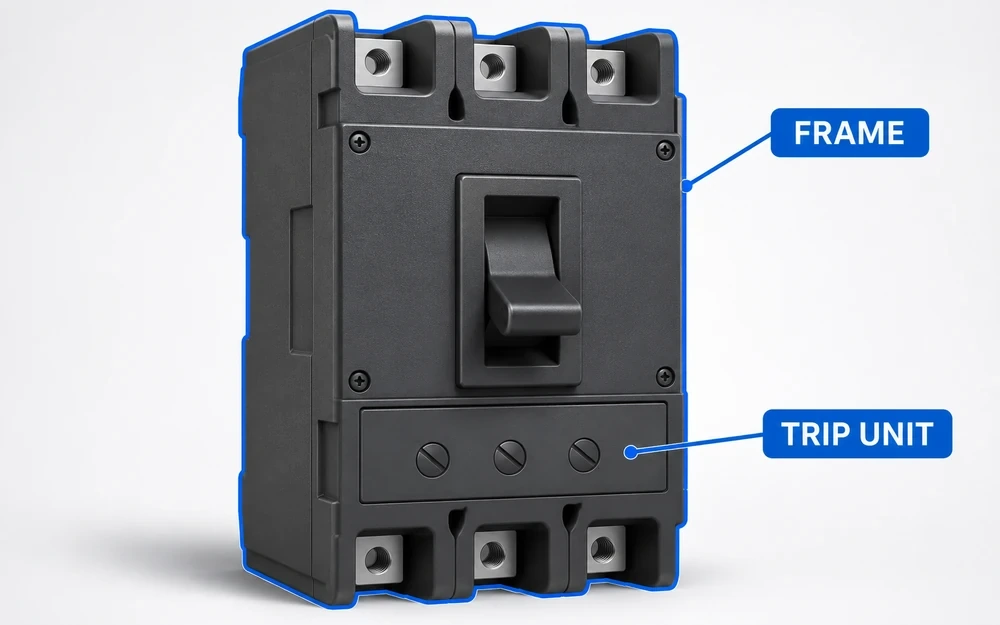
The frame rating describes the current-capacity class of the breaker construction. It may be written as an ampere-frame value, such as 250 AF. The fitted trip unit can have a lower rating, and some trip units allow adjustment within a stated range.
Keep these values separate when comparing products. A 250 AF marking does not by itself mean the circuit will receive 250 A overload protection. Likewise, choosing a lower trip rating within a shared frame does not necessarily reduce the body dimensions.
Body Dimensions and Number of Poles
Width, height and depth describe the physical body. Pole count often changes the width because the additional pole needs another current path. Height and depth may remain unchanged within a particular design.
Compare the version your circuit actually requires. A smaller width is not a reason to omit a required pole.
Voltage and Breaking Capacity
Rated voltage establishes the circuit conditions in which the breaker can be applied. Breaking capacity describes its ability to interrupt a specified fault current at a stated voltage; it is normally expressed in kA.
These ratings are separate from the frame’s ampere value. A physically suitable 400 A breaker can still be unsuitable for the project’s voltage or available fault current. Compare the electrical ratings at the actual system voltage before treating two bodies as alternatives.
Mounting Version and Operating Conditions
Fixed, plug-in and withdrawable versions can occupy different overall dimensions. Decide which version you are comparing before choosing a physical size.
Temperature also affects current selection. For thermally sensitive trip units, a hot location can change the usable current rating. Use the applicable temperature data rather than assuming the same ampere figure applies under every operating condition.
Common MCCB Sizes and Applications
The following frame references cover different levels of equipment and power distribution. Each section explains the relevant size characteristics and where that class enters a selection. The circuit’s electrical requirements determine suitability, not the equipment’s industry name alone.
30, 50 and 60 A MCCB Frames
These lower-current frames can serve smaller equipment supplies and branch circuits where an MCCB is specified. Their compact dimensions are useful when you need molded-case protection without moving to a larger frame simply for its current capacity.
One three-pole design measures 75 × 130 × 68 mm across these frame references. The main choice within that shared body is therefore the required electrical rating, not a difference in external size.
For a low-current circuit, first establish whether the project calls for an MCCB or an MCB. Similar ampere values do not make the two product categories mechanically or electrically interchangeable.
100, 125 and 160 A MCCB Frames
These references are encountered in equipment power circuits and smaller distribution feeders. They give you several options before moving to a 225 or 250 A frame class.
The chart illustrates why the frame number alone is a poor guide to physical size. A 125 A three-pole example measures 90 × 130 × 68 mm. In another family, a 160 A frame shares a 105 × 161 × 86 mm body with 100 and 250 A versions.
For your comparison, distinguish a larger capacity class from a larger product. A move from 100 to 160 A within a shared-body family may leave the external size unchanged. Moving between families can change all three dimensions even when the ampere value stays the same.
225 and 250 A MCCB Frames
A 225 or 250 A frame is relevant to machine supplies and distribution feeders whose required trip rating falls within the selected range. Typical examples include the supply to production equipment or a feeder serving a downstream distribution board.
Two three-pole dimensional examples in this part of the market are 105 × 165 × 68 mm and 105 × 161 × 86 mm. They have the same width, but the second is deeper. Calling both “250 A size” would hide that difference.
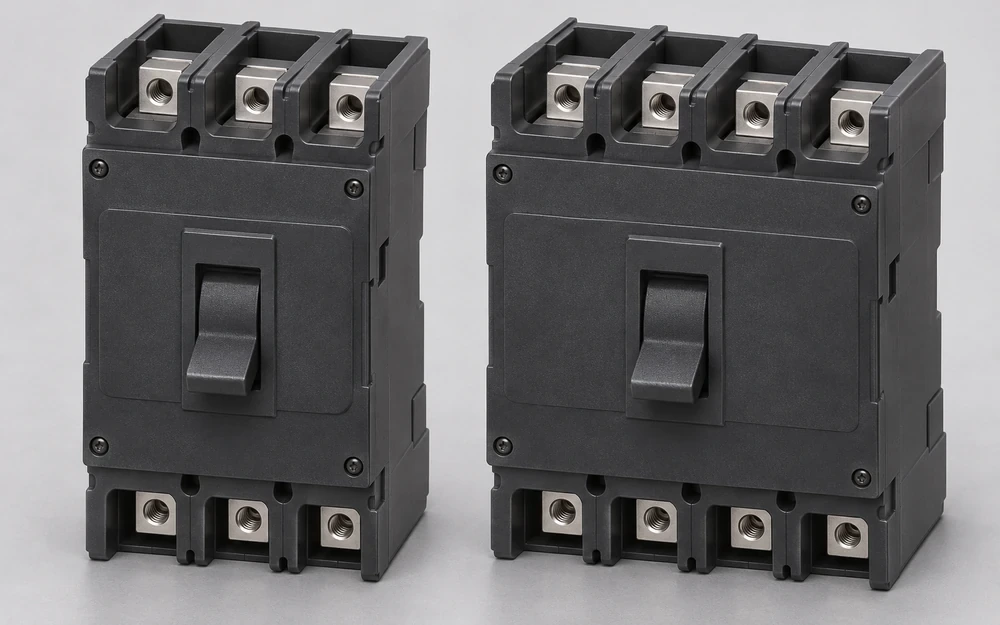
Pole count introduces another distinction. In the second design, the four-pole version measures 140 × 161 × 86 mm. The added pole increases width by 35 mm without changing height or depth.
Choose the electrical configuration first, then compare the body dimensions of those versions.
400 A MCCB Frames
The 400 A class is relevant to distribution feeders and equipment supplies with requirements beyond smaller frame ranges. At this level, compare the body proportion as well as its overall volume: a short, wide design and a tall, narrow design may fit different available spaces.
A representative three-pole body measures 140 × 260 × 103 mm. A four-pole version of that design is 185 × 260 × 103 mm. In another product family, a three-pole 400 A example is 140 × 255 × 110 mm.
That comparison shows a practical trade-off. The second body is slightly shorter but deeper. If depth is the limiting dimension in your project, comparing height alone can lead you toward the wrong option.
600 and 630 A MCCB Frames
These frame references are used for larger feeders and main or sub-main distribution duties, subject to the selected breaker’s electrical ratings. A compact option can be particularly relevant when the required current increases but the available installation space stays fixed.
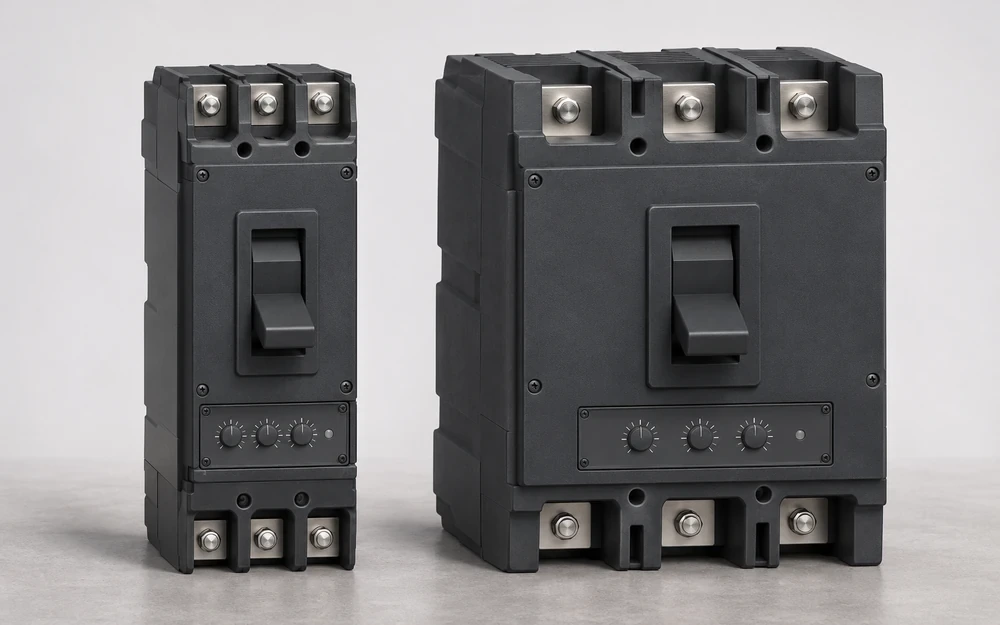
Published examples include both 140 × 260 × 103 mm and 210 × 273 × 103 mm three-pole bodies. The width difference is substantial even though both designs are offered in this frame class.
For a constrained location, compare the compact option’s full electrical specifications against the project requirements. A wider body does not automatically provide the required fault rating, and the more compact design should not be rejected merely because it is smaller.
800 and 1000 A MCCB Frames
These sizes are relevant to main distribution and substantial feeder circuits. The physical range also becomes more varied: some products continue a body family used by lower-current frames, while others use a taller construction.
An example shared by 800 and 1000 A versions is 210 × 273 × 103 mm. Another fixed three-pole 1000 A design measures 210 × 327 × 147 mm. Identical width therefore does not establish equivalent overall size.
When your project has a fixed maximum height or depth, use those limits to compare electrically suitable products.
1200 and 1250 A MCCB Frames
You will encounter these nearby frame references in different product ranges serving larger feeder and main-distribution applications. They are distinct ratings, not two labels that should be treated as interchangeable.
A three-pole 1200 A example is approximately 211 × 406 × 140 mm. A 1250 A example measures 210 × 370 × 120 mm. Here, the higher-numbered frame is physically shorter and shallower.
Use this comparison to avoid a common assumption: greater ampere capacity does not always require a larger external body. Where space is limited, compare different suitable designs rather than selecting solely from the ascending frame numbers.
1600 A MCCB Frames
The 1600 A class is relevant to major distribution feeders and incoming circuits that require this level of capacity. It also demonstrates how differently manufacturers can package a similar frame rating.
One three-pole design measures 210 × 370 × 140 mm. Another body family covering 1600 A is approximately 394 × 406 × 249 mm. The difference cannot be explained by the 1600 A marking alone.
Where width is your limiting dimension, the 210 mm-wide example is the more compact starting point; the alternative is approximately 394 mm wide. If both widths fit but depth is restricted, the first example again takes less space: 140 mm rather than approximately 249 mm. Compare these dimensions only among designs that meet the circuit’s electrical requirements.
2000 and 2500 A MCCB Frames
These references appear in higher-capacity distribution equipment, including main and large feeder duties. A three-pole body family covering both ratings measures approximately 394 × 406 × 249 mm; the same family also includes a 1600 A frame option.
This shared construction means that moving between those references does not necessarily change the basic external size. It does not mean an existing breaker’s current rating can simply be increased. Trip-unit compatibility and the complete circuit requirements still govern the available choice.
At this end of a product range, confirm the breaker category as well. An air circuit breaker is a different product construction; its dimensions should not be inserted into an MCCB chart merely because the ampere rating is similar.
How to Choose the Right MCCB Size
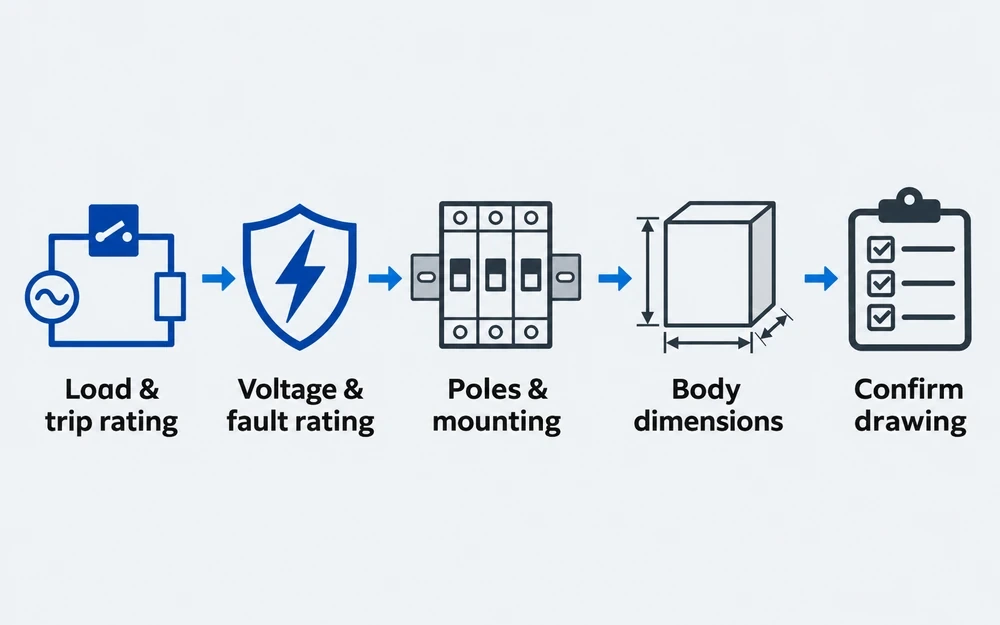
Choose the electrical capacity and protection first, then compare the physical sizes of products that satisfy those needs. This keeps a convenient footprint from driving an unsuitable electrical selection.
Start with the circuit’s required rating. Use the design load and applicable conductor-protection requirements to identify suitable trip ratings. For motor circuits, the protection arrangement also needs to account for starting conditions. There is no single percentage increase that correctly sizes every MCCB application.
Compare the required electrical performance. The breaker needs the appropriate voltage rating and sufficient breaking capacity for the available fault current. For devices used together, check the required protection coordination. A larger frame alone does not establish any of these results.
Select the pole count and mounting version. These decisions affect which dimensions you should compare. Use the body dimensions of the required version, not those of a smaller configuration that cannot serve the circuit.
Compare the dimension that actually limits your choice. If two suitable products have the same width, compare height and depth next. Where a larger frame shares the same body, reducing the current rating may offer no physical-space benefit.
Keep future capacity separate from today’s protection setting. A larger frame may accommodate other approved trip options within its product range. Future use still depends on the complete circuit design; do not raise the protection setting simply to use the frame’s maximum capacity.
FAQs About MCCB Sizes
Can You Replace an MCCB with Another of the Same Physical Size?
Matching width, height and depth is not enough. The replacement must also have suitable electrical ratings and a compatible mounting and connection arrangement. For a listed or otherwise verified assembly, an unapproved substitution can also affect the status of that assembly. Use the applicable replacement documentation rather than selecting by body dimensions alone.
Are MCCB Mounting Dimensions Standardized Across Brands?
There is no single cross-brand mounting footprint that follows automatically from a frame’s ampere value. Two 250 A frames can have different fixing centers even when their external sizes look similar. Use the mounting drawing for the selected design.
Does a Higher Breaking Capacity Always Mean a Larger MCCB?
No. Different breaking-capacity versions can share the same external dimensions within a product family. Compare the stated kA rating at your system voltage separately from the body size; neither value can be reliably inferred from the other.
Why Can the Dimensions on a Product Page and a Drawing Differ?
They may describe different configurations or measurement boundaries. One can show the basic body while another includes an operating mechanism or connection accessories. Packaging dimensions are another possible source of confusion. Match the product reference and the configuration before comparing the numbers.
Final Thoughts
Standard MCCB sizes help you compare frame classes, but the actual dimensions belong to a specific design and configuration. Use the size chart to compare body proportions, then choose a product whose electrical ratings and physical dimensions both suit your project.
 English
 Arabic
 French
 Spanish
 Russian
 Japanese
 Korean
 Portuguese
 Indonesian
 Chinese