


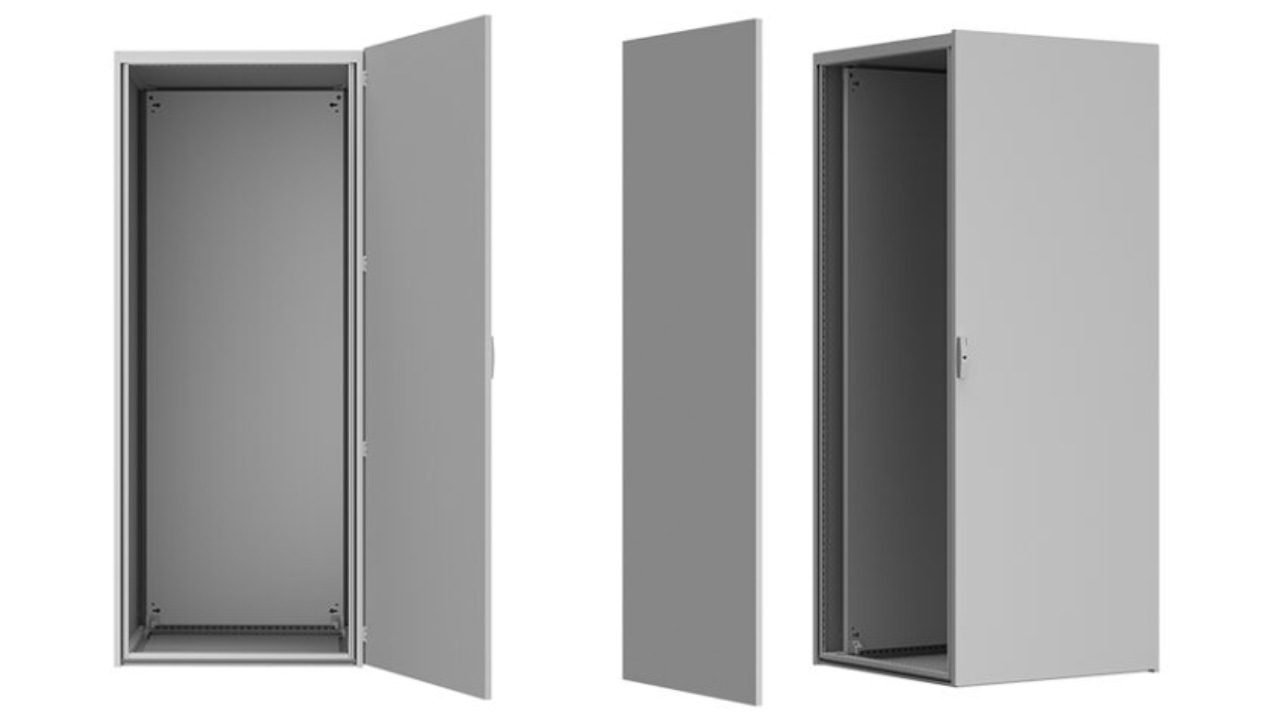
Selecting the appropriate safety gear for your electrical and industrial systems is more than just picking up a box; it is a smart choice that affects your workflow and bottom line. Knowing the differences between modular and standard enclosures is important for long-term success, whether you are a plant manager in charge of a huge factory floor or a control panel builder trying to save time and money.
What Is a Modular Enclosure?

For modular enclosures, think of an industrial cabinet building kit. Pre-designed aluminum extrusion profiles are used to build modular designs. These profiles connect with corner pieces and special joinery. You can put panels, doors, and fixing plates on this frame exactly where you need them. The cover can be changed to fit new needs without having to buy a whole new unit, due to this flexible design philosophy.
What Is a Traditional Enclosure?

Traditional enclosures, which are also called welded or mono-block enclosures, are made from steel or stainless steel sheet metal that is cut, bent, and welded into a fixed form. From the moment it leaves the factory, this rigid, one-piece design is very stable and long-lasting. They are custom-made to fit a certain set of parts, and once they are made, their sizes and mounting arrangements cannot be changed.
Top 10 Key Differences between Modular Enclosures and Traditional Enclosures

1. Design Flexibility & Adaptability
Cerramientos modulares
Think of these as being fluid. Need an extra side window to see out of? Put a glass panel in place of a metal door panel. With the extrusion shapes, you can add or remove parts from anywhere along the frame. This makes it much easier to make last-minute changes to the design.
Traditional Enclosures
These are stiff. When they make something, their plan is set in stone. Adding a vent or a new part later usually means drilling, cutting, or welding on-site, which can damage the unit’s finish and protective structure.
2. Installation Time & Process
Cerramientos modulares
They come in a flat-pack kit, which makes shipping a lot easier. Putting something together is like following a clear set of instructions with simple tools. System integrators can save a lot of time and effort by using this streamlined building process instead of starting from scratch or moving around heavy welded boxes.
Traditional Enclosures
It turns out that they are already put together, which is great for “plug and play,” but they are heavy and hard to move around. Moving the cabinet into place often takes more than one person or a lot of heavy equipment, which adds to the time and risk of harm on the job site.
3. Customization & Configuration
Cerramientos modulares
You decide how things are set up. You can customize everything about it, from the number of doors to where the mounting plates and DIN rails go. This is great for jobs that need non-standard heights or depths without having to wait for a custom fabrication run.
Traditional Enclosures
Most of the time, customization happens before production. Ordering a custom soldered unit is the only way to get a specific hole pattern or size. This usually takes longer and costs more up front than putting together a modular version.
4. Cost Efficiency — Initial vs Lifecycle
Cerramientos modulares
The cost of the part may be a little higher at first, but it will save you money in the long run. Instead of buying a new container, you can use the frame for another project or add on to it later. This ability to change makes it more valuable in the long run for changing industry uses.
Traditional Enclosures
These usually have a lower price when you first buy them. But if the needs of your project change, you might have to throw away and replace the whole unit, which will cost you more in the long run. The price is set for just one use case.
5. Ease of Maintenance
Cerramientos modulares
It is easy to maintain. You can take out a side panel that gets dented, repair just that part, and not have to take the whole system apart. This modularity makes it easy for techs to quickly replace parts or fix internal parts without having to deal with a single-piece structure.
Traditional Enclosures
Usually, there is only one front door that leads inside. It can be hard to work on parts deep inside a big welded cabinet. Also, if the enclosure is broken, it is hard to fix the welded gap or replace a panel.
6. Scalability & Future Expansion
Cerramientos modulares
This is what makes them special. With the extrusion profiles, it is easy to add more bays to the current frame as your automation project grows. Daisy-chaining units together allows you to make a smooth control center without having to buy a whole new, bigger box.
Traditional Enclosures
It is hard to expand. If you run out of space, you will usually have to buy a second separate unit and put it close by. This takes up more floor space and needs pipe runs to connect the two boxes.
7. Structural Integrity & Material Use
Cerramientos modulares
The frame is made of extruded metal, which makes it strong for its weight. The load is on the frame, which makes the panels lighter. This strong skeleton makes the cage very rigid, which is especially helpful for bigger enclosures that might bend otherwise.
Traditional Enclosures
The sheet metal that is bonded together is what makes it strong. This makes a very rigid box, but for bigger sizes, stronger steel is often needed to keep them from twisting, which adds a lot of weight. The integrity is heavy and even.
8. Aesthetics & Modern Look
Cerramientos modulares
They look modern and high-tech because they have straight lines, clear extrusion shapes, and pieces that fit together neatly. This simple style is often chosen for open spaces or places that want to show off high-tech equipment.
Traditional Enclosures
They make you look easy and helpful. It may look old, but the wrapped sheet metal with straight lines still works fine. Plant managers often choose the flexible look when they want to set up how the office looks.
9. Handling and transporting
Cerramientos modulares
They come in a small box as a set. This is great for shipping because it lets more things go at once and is simple for one person to move up and down stairs and front doors.
Traditional Enclosures
It costs a lot and is risky to move traditional enclosures. It costs more to ship these big, empty boxes because they take up more room. They are more likely to dent or bend while being moved, and they are harder to move around in small spaces.
10. Compatibility with Standard Components
Caja modular
When it comes to modular enclosures, the inside forms are made with T-slots or threaded holes. With this, you can quickly put in plates, wire ducts, and standard Riel DIN tracks without having to drill holes. This is very important for people who make control screens.
Traditional Enclosures
There are stock parts that can be used with these enclosures, but you may need to drill and tap a mounting plate or the back panel to get them to work. This makes getting it together take longer for people who work with power.
Comparison Table: Modular vs Traditional Enclosures

| Característica | Cerramientos modulares | Traditional Enclosures |
| Estructura | Extruded aluminum frame with bolt-on panels | Welded sheet metal (steel/stainless steel) |
| Flexibilidad | High; can be reconfigured on-site | Low; fixed design |
| Instalación | Flat-pack assembly; manageable by one person | Pre-assembled; often requires lifting equipment |
| Personalización | User-configurable with standard parts | Manufacturer-dependent; often custom order |
| Lifecycle Cost | Lower long-term cost due to reusability | Higher if modifications are needed later |
| Mantenimiento | Easy; individual panel replacement | Difficult; often requires whole unit access |
| Expansion | Easy to add sections/bays | Difficult; usually requires a new separate unit |
| Shipping | Compact, lower cost | Bulky, higher cost |
| Estética | Modern, high-tech industrial look | Traditional, utilitarian look |
Modular vs Traditional Enclosures – Which One Is Best?

Modular cages are probably the best option for those wishing to change their project in the future, to have profuse technology in it, and/or make it easy to install and maintain. They assist you in coping with change more easily. A simple welding enclosure is a good option when one lacks substantial funds and merely wants something that will remain in position. Lastly, the optimum option will be based on the speed of use or the option of how easily you would like to gain access to replacing it in the long run.
Customized Enclosure Type by KDM Steel

We understand that metals are difficult to comprehend at Acero KDM. You may have the plain, solid metal case or the modular system, which may be assembled in varied combinations. We would be happy to help you sift through these choices to determine the best and cheapest ones for your business or electrical requirements. Contáctenos immediately to discuss what you require in your project.
Preguntas frecuentes
Is one of them superior to outdoor use in general?
Stainless steel tanks or enclosures that have been welded are generally the most suitable in extreme outdoor conditions, as they are totally sealed. The modern modular enclosures, however, having high-quality gaskets and sealed corners, are very effective outdoors and are simpler to repair indoors.
Which enclosure type is easier to install and set up?
One can transport flat-pack sections to a basement or control room and assemble them there, hence making modular shelters perfect in locations that are space-constrained. With a clear path and a forklift, orthodox enclosures are more manageable, but they become extremely difficult to maneuver when it comes to fitting into tight areas.
Can I add on to modular containers without the use of special tools?
Yes. All you require to assemble them is simple hex keys and screwdrivers. New panels or parts can be added to your site by your workers with little effort, without the assistance of a metal fabricator or special welding equipment.
Do modular enclosures maintain easier compared to regular shelters?
In most cases, yes. Any part can be removed to access the rest of the parts at any angle. It is also much easier to repair and change parts, which would otherwise be possible through a single door in a normal enclosure.
Should electrical parts be in modular enclosures rather than the traditional ones?
Safety is also very crucial in both. Conventional enclosures have been found to be safe, and modular enclosures can provide better grounding using the metal frame. Divider screens can also be added to segregate high-voltage spaces and low-voltage controls. This will ensure that the technicians are safe.
Is it possible to move movable panels to increase airflow or cooling?
Yes. When a modular box overheats unnecessarily, all one needs to do is replace a solid side panel with a ventilated panel or filter fan unit. This dynamism, in the real sense, prevents the electronic cooling without necessarily having to ship the entire cabinet back to the manufacturer.
Is corrosion resistance different between the two?
Both can be resistant to rust, so standardization of electricity enclosures is necessary. Traditional structures are done by means of paint systems or stainless steel. In the case of the use of aluminum extrusion in the modular shelters, it will automatically create a protective layer of oxide that keeps the rust out without even needing to have the extrusion painted.
Which types of businesses are the most advantageous with movable enclosures?
Some of the industries that are changing and technology-driven include automotive manufacturing (which is often retooled), data centers, and green energy (which is growing solar and wind farms). Their growth potential is ideal in these dynamically changing environments.
What part do business standards play in the decision between modular and traditional enclosures?
Both are capable of adhering to UL, NEMA 4, or 12. Checking is very important. Similar to a traditional welded unit, ensure that the modular system that you purchase has been certified and tested to the appropriate level of ingress protection (IP) and impact rating.
 Spanish
  English
  Arabic
  French
  Russian
  Japanese
  Korean
  Portuguese
  Indonesian
  Chinese