


Choosing the proper IP rating enclosure is an issue you cannot avoid. This article helps project managers and system integrators understand the differences between IP20 and IP56 in protection capabilities, and helps you choose the right enclosure based on your actual needs.
What Are the IP Ratings?
The Рейтинг IP (Ingress Protection Rating) is an international standard that defines how well electrical enclosures protect against solids and liquids. It is defined according to the International Electrotechnical Commission standard IEC 60529.
The IP rating is followed by two digits. The first digit indicates the protection capability against solid objects. The larger the number, the better the protection. The second digit indicates the water ingress protection capability.
What is an IP20 Rating?
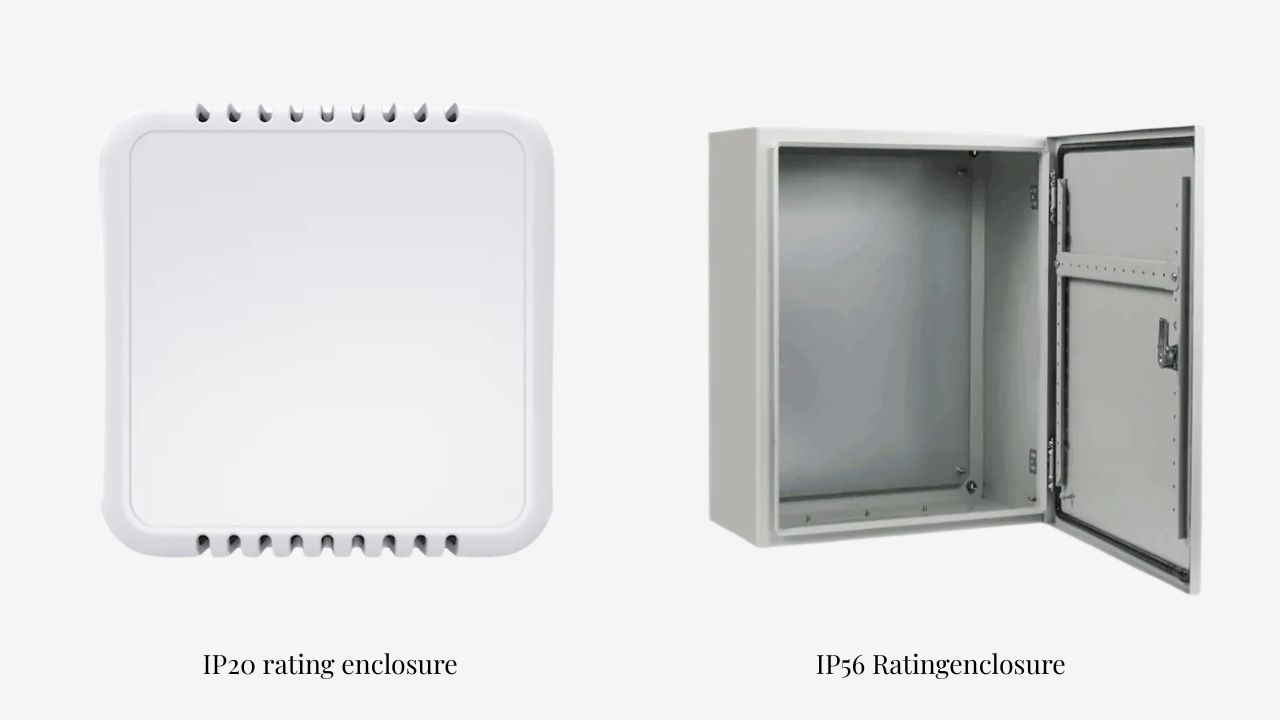
The IP20-rated enclosures are designed for safe indoor environments. The electrical enclosure with an IP20 rating can prevent solid objects larger than 12.5 mm, but it does not provide waterproof protection. Therefore, IP20 can provide basic safety protection, and it is usually more cost-effective and easier to install.
What is an IP56 Rating?
The IP56 electrical enclosure provides a high-level protection and can be applied in harsh or outdoor environments. The first digit 5 indicates that the enclosure is dust-protected. Although it is not completely dust-tight, dust will not harm operation. The second digit 6 can prevent powerful water jets from any direction, guaranteeing that water ingress does not cause harmful effects.
The IP56-rated enclosure features a more robust and sealed structure, providing powerful dust and debris protection and against high-pressure water jets.
IP20 vs IP56: Key Differences Explained
The differences between IP20 and IP56 are very obvious. They differ substantially in solid object protection and liquid ingress protection. Here is a detailed explanation of the differences between the two:
Solid Protection Level
The first digit ‘2’ in the IP20 rating indicates that solid object protection level is no more than 12.5mm. Such enclosures can prevent your fingers from accidentally touching or affecting the device’s internal components.
The highest level of dust protection is 6, which can achieve complete dust prevention. The first digit 5 in the IP56 rating indicates that the enclosure can prevent most of the dust. Although it cannot completely prevent the dust ingress, dust ingress volume that enters will not affect the normal operation of your equipment.
Therefore, IP56 provides better solid object protection than IP20.
Water Protection Level
The second digit “0” in the IP20 enclosure indicates that the enclosure does not have waterproofing capabilities.
IP56-rated enclosures have excellent water ingress protection. The second number 6 indicates that they can withstand strong water jets. Your device can resist direct, powerful water streams from any direction and will not cause any harmful effects to your equipment.
Suitable Environment
Obviously, you know that IP20 is the minimum safety standard. It only makes sure that you won’t accidentally touch the internal circuits and larger tools cannot be inserted. Therefore, your device needs to always be installed in a dry and clean indoor environment, and it may need to be placed inside a larger protective enclosure or a distribution cabinet.
The IP56 enclosure is designed for harsh environments. If your equipment needs to be exposed outdoors, or if there is rain or splashing water in the environment, or if the ground needs to be washed with water, an IP56 enclosure is indispensable for you. IP56 is more waterproof than IP54, guaranteeing your equipment’s reliability in humid and dusty environments.
Installation Complexity
IP20 enclosures are usually installed inside standard distribution boxes and control cabinets. You can also directly install them on indoor ceilings or dry walls. Also, IP20 enclosures are very simple to wire. The wiring does not require special techniques and the installation does not have any special base requirements.
IP56 enclosures are different from IP20. IP56 enclosures can be directly exposed to outdoor or humid environments as standalone devices. During installation, you need to consider the drainage slope, prevent backflowing water and direct sunlight exposure. And, the IP56 enclosure’s wiring process is very complicated. Wiring must follow strict process standards to avoid compromised protection.
Требования к техническому обслуживанию
If you install the IP20 housing in a dusty and enclosed cabinet, you need to service and clean the dust regularly. If it’s a clean environment, you’ll have almost no maintenance. However, for IP56, you need to conduct periodic checks, including the gaskets and waterproof connectors inspection.
Heat Dissipation
The IP20 enclosures typically rely on natural ventilation, which facilitates heat dissipation. The IP56 seal is tighter than the IP20, so additional cooling methods such as heat exchangers or fans are required.
Due to the IP56 better sealing performance, the internal components are less likely to accumulate dust. However, you need to clean the dust on the enclosure exterior to keep the cooling efficiency.
Расходы
IP56 has a higher cost than IP20. The IP20 enclosure is usually made of common plastic, and the accessories used are ordinary cable conduit and cable connectors. Therefore, the IP20 enclosure has a lower cost.
On the contrary, to achieve a higher dust and water resistance, IP56 uses higher-level sealing rings and enclosures, and it is equipped with cables and cable connectors of the same protection level. Therefore, its cost is higher.
Typical Uses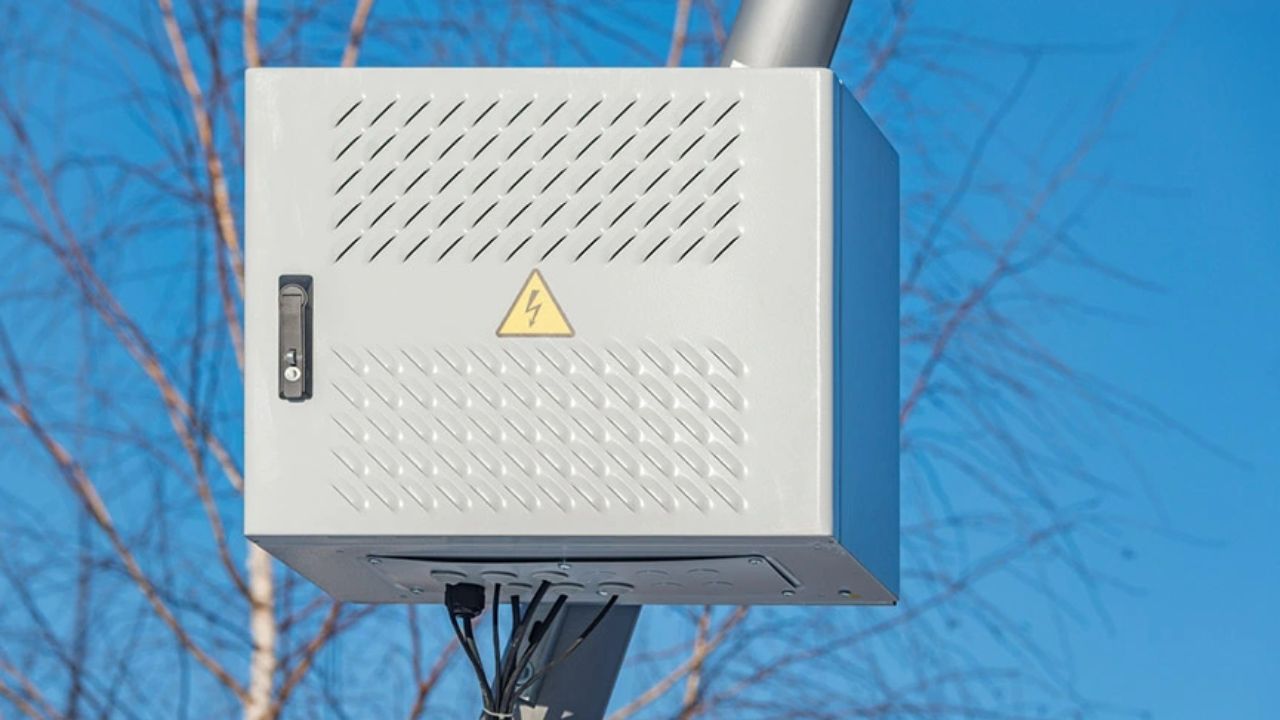
The IP20 enclosure can be applied to control cabinets inside your workshop, floor communication rooms in office buildings, server cabinets in data centers, etc. It can’t be used outdoors.
The IP56 enclosure can be applied to frequently cleaned workshop areas, woodworking workshops in dusty environments, outdoor charging stations, etc. The IP56 can be directly exposed to rain, snow, dust and salt fog.
How to Choose Between IP20 and IP56?
Evaluate Your Installation Environment
If the installation environment is a clear and dry indoor space, such as a control room or office building, you can choose IP20.
If the installation environment is exposed to dust, rain, water spray or outdoor conditions, you need to choose IP56.
Consider Safety and Industry Requirements
If you only need to provide basic personal protection and there are no other engineering requirements, IP20 is sufficient.
If you want to protect equipment from environmental damage and downtime, or if you are using it in industrial plants and outdoor infrastructure, IP56 is the appropriate choice.
Budget Considerations
IP20 has lower costs, simpler installation and easier maintenance. IP56 usually has a higher initial cost, but it is more durable and can reduce the risk of failure.
Therefore, you need to balance cost and security to make the right choice. Besides, you also need to consider whether the installation environment will change and whether dust and moisture will increase over time.
Часто задаваемые вопросы
Can IP20 or IP56 Ratings Change After Installation?
Yes. The actual IP20 and IP56 protection level may change after installation. Incorrect installation, damaged seals, poor cable entry, or later modifications can reduce the enclosure effectiveness. The IP56 sealing will largely affect the actual IP rating. Therefore, you need to regularly check and install correctly.
How Do Cable Glands and Accessories Impact the Final IP Rating?
The cable gland accessories directly affect the IP rating. If the glands, seals, or fittings of the enclosure have different grades or are installed improperly, gaps will occur, allowing dust or water ingress. Eventually, the actual IP rating of the enclosure will decrease.
Does IP56 Provide Protection Against Condensation Inside the Enclosure?
No. IP56 cannot prevent condensation inside the enclosure. IP ratings only protect against external substances, such as dust and water. Temperature changes will directly cause condensation inside the enclosure. This usually requires taking additional measures to solve, such as ventilation or anti-condensation heaters.
Can an IP20 Enclosure be Upgraded to IP56?
No. An IP20 enclosure usually cannot be upgraded to IP56. To reach IP56 standard, it requires sealing with gaskets, testing of jointed points and construction certification. Simply adding a cover and seal to the IP20 enclosure will not meet the IP56 standard.
Final Thought
As a professional electrical enclosures manufacturer, KDM can provide you with electrical enclosures of various protection grades. Our factory adopts advanced production techniques and has many years of production experience. If you have any customization requirements, we can provide you with comprehensive customized services. Связаться с нами now.
 Russian
  English
  Arabic
  French
  Spanish
  Japanese
  Korean
  Portuguese
  Indonesian
  Chinese